
Criminal Cases in the Medina County Courts
Medina County criminal court cases split at the charging stage. Felonies are filed with the District Clerk for the district courts. The research identifies the 38th and 454th Judicial District Courts as Medina County felony courts, with the 454th court office at the courthouse annex. Class A and B misdemeanors go to the County Court at Law, and its filed records are kept by the County Clerk. This split is about the filed charge, so an arrest label does not by itself tell a reader which clerk will hold the later case.
Fine-only Class C charges and ordinance matters may remain with one of Medina County's four justice courts or a city municipal court. Those lower courts keep their own dockets. The main county criminal portal should not be treated as an index to every ticket or city case. Start with the charging instrument: an indictment points to a district file, an information usually points to the County Court at Law, and a fine-only complaint may stay in the issuing court.
Two Medina County Criminal Clerks
The courthouse annex at 1300 Avenue M houses both main criminal-record custodians, but they use different rooms and schedules. The District Clerk is in Room 201 and is open Monday through Friday from 8:00 a.m. to 5:00 p.m. The County Clerk is in Room 163 and closes at 4:30 p.m. Both offices offer a public terminal and a clerk-assisted name search for $5 per person. Calling before a trip is wise because the County Clerk expressly recommends confirming which documents are needed.
District Clerk
1300 Avenue M, Room 201
Hondo, TX 78861
830-741-6070
Monday-Friday, 8:00 a.m.-5:00 p.m.
County Clerk
1300 Avenue M, Room 163
Hondo, TX 78861
830-741-6040
Monday-Friday, 8:00 a.m.-4:30 p.m.
The Medina County Clerk page shows the misdemeanor search and copy routes.
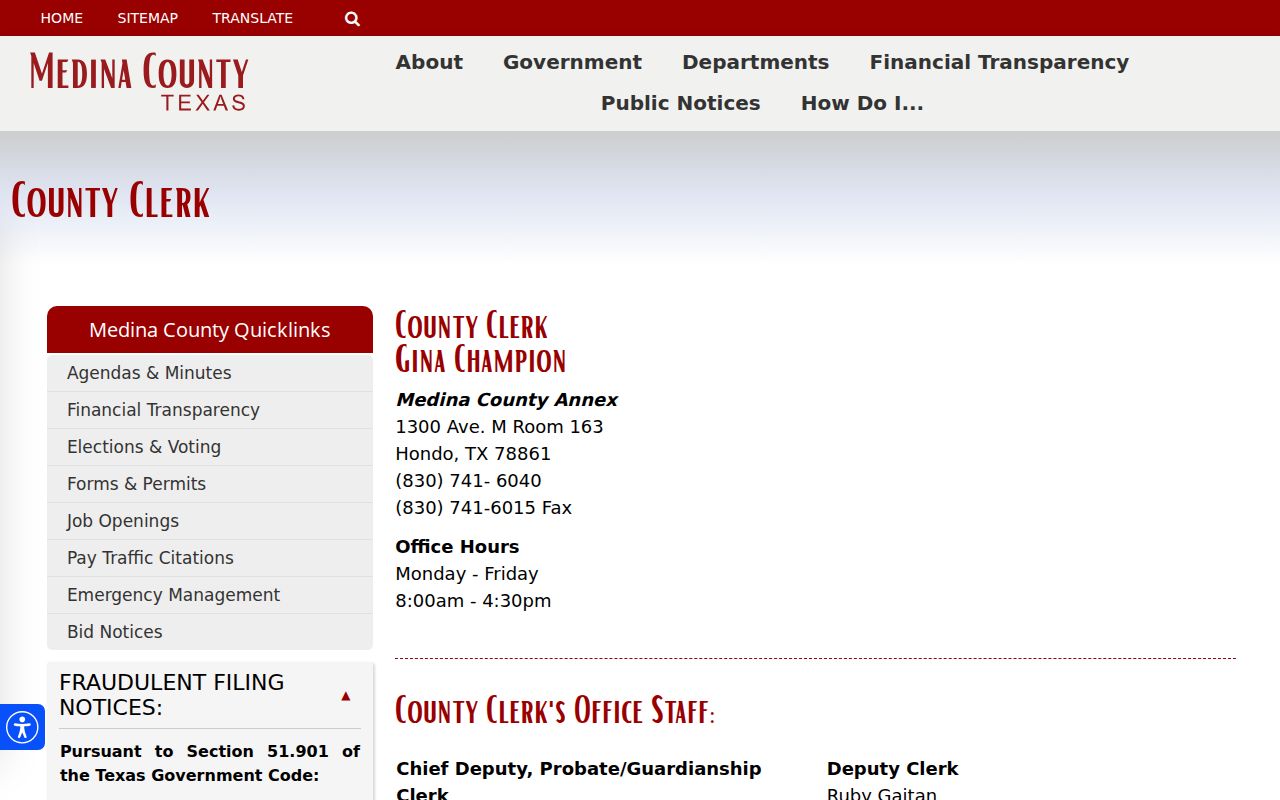
This office is the local source for filed County Court at Law misdemeanor records, not felony district files.
How to Search Case Records
The official Medina County Tyler Public Access portal is described by the county as covering court records and calendars from 1990 to the present. The research browser received an access-denied response, so no unverified portal labels or result columns are presented here. A reader who cannot reach a Medina County criminal case online still has firm fallbacks: the public terminal, a clerk-assisted search, a scoped mail request, or a request for a known document.
- Identify whether the filed charge is a felony, Class A or B misdemeanor, or a fine-only city or justice-court matter.
- Try the official Medina County Public Access portal for its stated 1990-present coverage.
- If the portal fails, call the District Clerk or County Clerk and confirm the correct Medina County criminal-record channel.
- Use the proper public terminal, or send a mail request with the person's name, period to search, requested result, payment, and return envelope.
- For a known filing, give the cause number and exact document name, then state whether a plain or certified Medina County copy is needed.
| Verified input | Channel | When it matters |
|---|---|---|
| Person's name | Staff or mail search | Required to identify whose Medina County index entries should be checked |
| Period searched | Mail search | Limits the clerk's search to the years stated by the requester |
| Desired result | Mail search | Tells the clerk what record or answer is being requested |
| Cause number | Known-document request | Connects the order to one filed Medina County criminal case |
| Document and copy type | Known-document request | Distinguishes a plain copy from a certified court record |
The Medina court access screen is the county's online starting point when it responds.
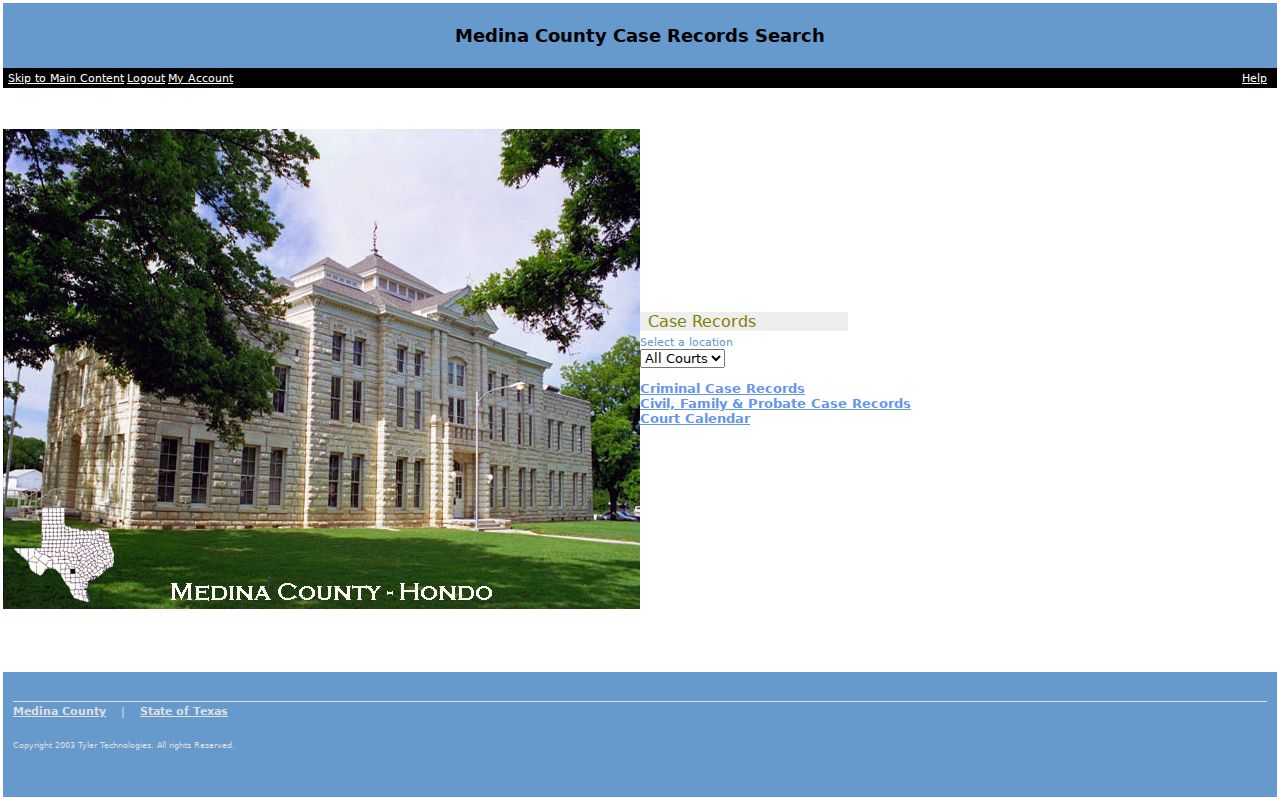
The screen does not remove the need to choose the correct Medina County clerk or verify a final judgment.
re:SearchTX Misses Medina County Criminal Cases
re:SearchTX is Texas's named statewide electronic court portal, but it does not replace the local Medina County criminal search. The Texas Judicial Council reports that the statewide document collection excludes criminal case records. A no-result response there therefore does not prove that Medina County has no criminal case. The right next step is the appropriate Medina clerk, the county portal, or the court that issued a municipal or justice-court complaint.
This limit also shows why a statewide DPS name result and a local court file answer different questions. DPS compiles reported Texas conviction and deferred-adjudication data for its public product. Medina County clerks hold the pleadings, settings, orders, judgment, and other filed papers for one prosecution. Use the local file to understand what the court did.
What the Case File Shows
A Medina County criminal case file follows the filed prosecution. Its most useful items are the charging instrument, docket, plea or verdict, judgment, and sentence. The docket is an event list, not the final word on the outcome. When a short entry and a signed judgment seem to conflict, the filed judgment is the sound source for the offense, degree, result, sentence, jail credit, community supervision, fine, costs, and special findings.
| Cause Number & Court | The local case identifier and the Medina County court assigned to the filing |
|---|---|
| Charging Document | The complaint, information, or indictment stating the charge the prosecutor filed |
| Docket Entries | A dated index of filings, settings, appearances, motions, and court action |
| Hearing Dates | Arraignment, pretrial, plea, trial, sentencing, and other settings recorded by the clerk |
| Disposition & Judgment | The filed result, including dismissal, plea, verdict, acquittal, or other outcome |
| Sentence & Conditions | Confinement, community supervision, fines, costs, jail credit, and special findings in the judgment |
A Medina County court file does not replace the agency arrest report or the DPS statewide compilation. It answers what happened after a charge was filed in this court.
Read Medina County Criminal Dispositions
Court terms can look alike while describing very different outcomes. A Medina County docket marked “disposed” only means that an outcome exists. It does not mean the outcome was a conviction. The judgment and related order should identify the actual result. Likewise, the arrest charge, filed charge, and offense of conviction can change as the prosecutor screens the case and the court process moves forward.
- Dismissed
- The filed charge ended without a conviction on that count; the arrest record is not erased by the dismissal alone.
- Deferred adjudication
- The court deferred a finding of guilt while imposing conditions; Texas may still make it public through the DPS product.
- No bill
- A grand jury declined to return an indictment on the matter presented.
- True bill
- A grand jury returned an indictment, allowing the felony prosecution to proceed.
- Capias
- A court command directing law enforcement to take a person into custody.
The Medina County Court at Law page links its criminal calendars and local forms.
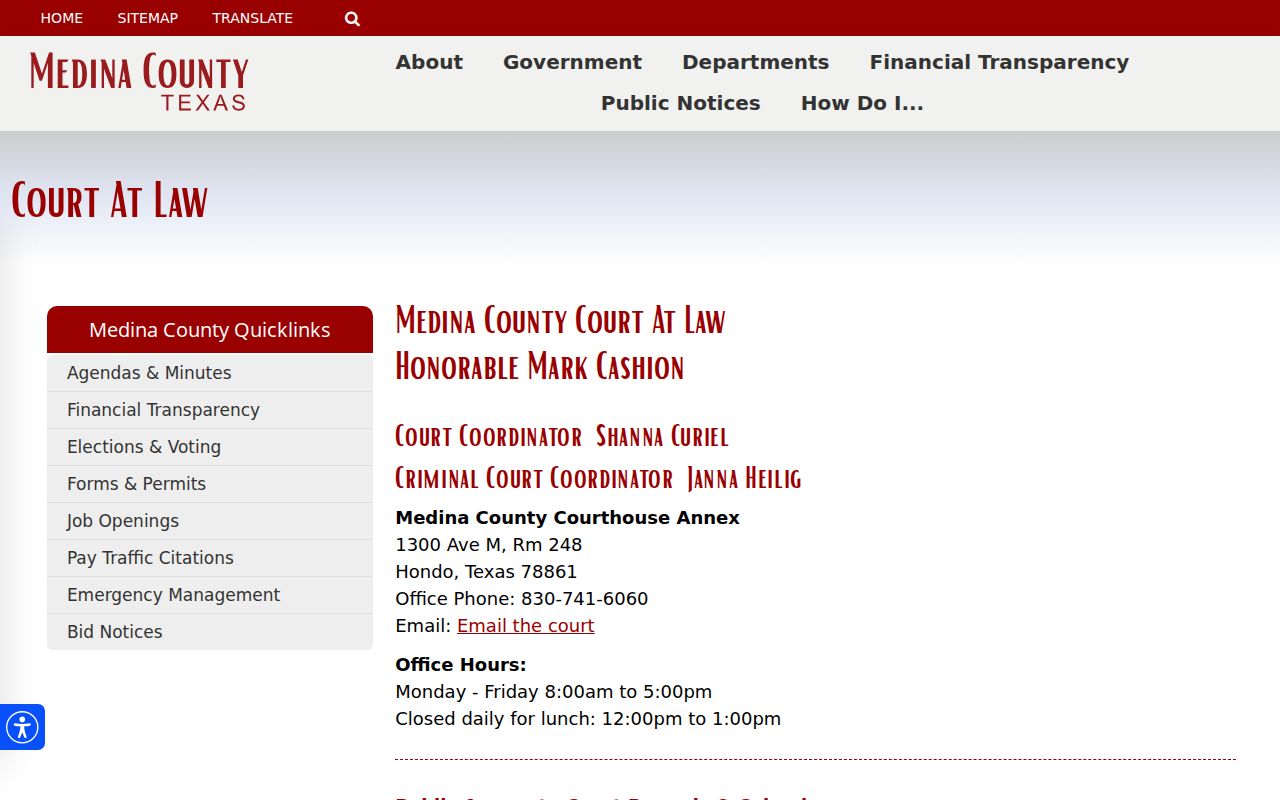
Those calendars help locate settings, while the Medina County filed judgment remains the key outcome record.
Stages of a Criminal Case
After an arrest and magistration, the prosecutor screens the matter and decides whether and how to file it. A complaint, information, or indictment begins the court-file stage. Arraignment records the plea, and pretrial settings may address motions, discovery, and bond. The case may then end by dismissal, plea, trial, or another lawful result. Judgment and sentencing follow when required, and an appeal can create a related appellate record.
Case flow: Charges Filed › Arraignment › Pretrial › Plea or Trial › Disposition › Sentencing
Texas law requires magistration without unnecessary delay and no later than 48 hours after arrest. That deadline does not predict how long the full Medina County criminal case will take. No local case-duration figures were published in the sources reviewed, so each docket must be read on its own terms.
Medina County Criminal Cases Before 1990
The county describes its online court access as running from 1990 to the present. A Medina County criminal case that predates that range may still exist even when it does not appear online. Call the proper clerk and ask about the public index, terminal, counter, or mail route. The District Clerk and County Clerk each charge $5 for a staff name search, while self-research at the clerk's public terminal is the separate route.
Mail searches need a written scope, payment by the stated method, and a return envelope. County Clerk results are not given by phone. District Clerk instructions allow a requester who knows the cause number and document to pay through Certified Payments, then email the payment ID and order details. District printed copies are $1 per page, email copies are $0.10 per page, and certification adds $5. County Clerk copies are $1 per page, with another $5 for certification.
Access & Restrictions
Texas court files do not use the same request law as a Medina County sheriff report. The Texas Public Information Act governs many executive-agency records, but judiciary information is outside that statute's usual route. Filed case records follow court-access law and rules, while judicial administrative records are addressed by Judicial Rule 12. Direct a criminal pleading or judgment request to the clerk that holds the case rather than sending it as a sheriff records request.
Juvenile matters, expunged files, nondisclosed data, victim information, Social Security numbers, and financial-account data may be withheld, sealed, or redacted. A restricted web view does not mean the clerk can release an unredacted copy. Ask which public document is available and whether a certified copy can be issued. For broader county record context, the Medina County criminal history overview explains how agency, jail, court, and DPS records differ.
Certified Medina County Criminal Judgments
A DPS criminal-history result can lag behind the Medina County court file or omit a reported disposition. When reviewing one's own record, first obtain the final Medina County judgment or disposition from the proper clerk. Ask for a certified copy. DPS says an ordinary photocopy from a private source is not enough for its correction process because the court certification and seal establish the official record.
The District Clerk's official Medina County record page provides the felony access route and office details.
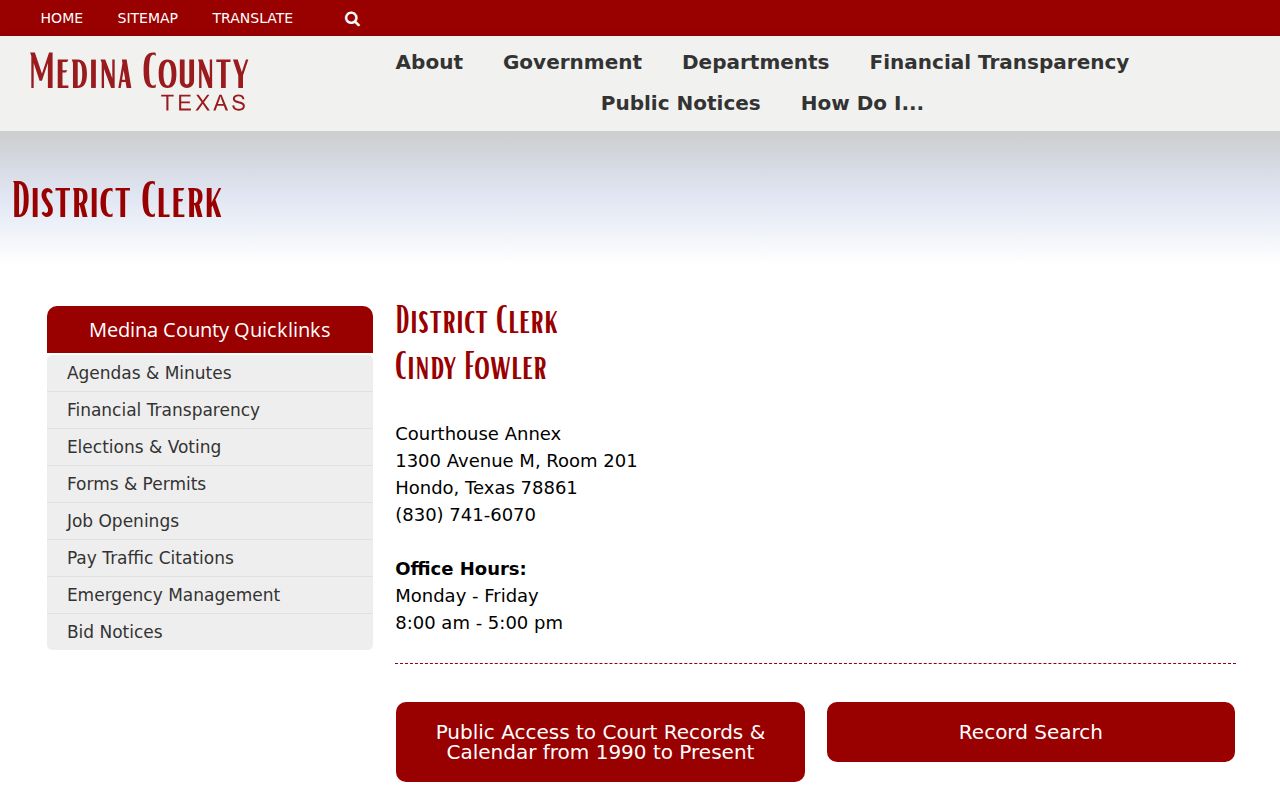
That clerk is the source for a certified felony judgment used to resolve a missing or wrong Medina County disposition.
Check the certified record against the DPS entry, then follow the Texas Department of Public Safety Error Resolution instructions. Keep the local cause number, court name, and certified document together. This path corrects the state compilation; it does not alter the local case unless the Medina County court itself enters a new order.